RepairRestorationReplacement

    Church Steeple Repair & Restorationin Eastern North Carolina

    Preserving sacred architecture with trophy-quality craftsmanship. Carolina Trophy Roofs repairs, restores and replaces church steeples — the part of the building most roofers will not touch. We inspect from a lift and from inside the belfry, fix the leaks at the base, repair the framing, recoat the deck the steeple stands on, clean the spire to the finial, and when a steeple has to come off, we lift it by crane and set it back.

    Serving congregations throughout Rocky Mount, Wilson, Greenville, Raleigh, Durham and all of Eastern North Carolina, from offices in Rocky Mount and Greenville.

    24/7 Emergency Leak Stoppage: (252) 302-2003

    Steeple work is booked by consultation
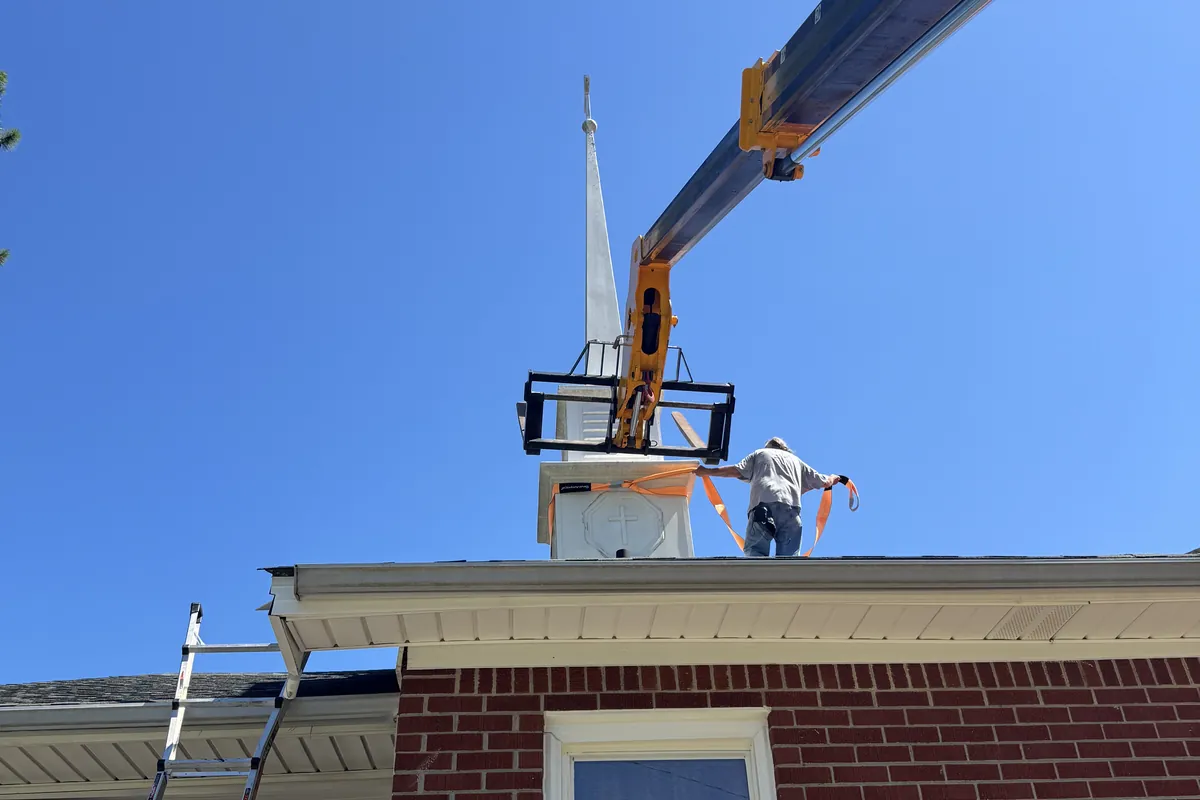
    A white church steeple with a tall spire being set onto the roof of a brick church by a lift boom, with a crew member on the shingle roof guiding it into place with orange rigging straps
    Setting a steeple back onto a brick church. The steeple hangs from the boom in rigging straps while a crew member on the roof guides it onto the base, which was repaired and made watertight while the steeple was off.

    North Carolina’s church steeple repair specialists

    Church steeples carry both architectural beauty and spiritual significance, and repairing them takes expertise well beyond standard roofing. A steeple is a tall, narrow structure of stacked stages — tower, belfry, lantern, spire, cross — built from several materials, joined at dozens of seams, and standing higher in the wind and weather than anything around it. Every one of those seams is a place for water to get in, and almost none of them can be seen from the ground.

    Since 2008, our master craftsmen have restored and repaired church steeples across Eastern North Carolina, combining traditional techniques with modern materials for both aesthetic authenticity and lasting structural integrity. Our restoration methods follow guidelines established by the National Park Service Technical Preservation Services and Preservation North Carolina, including the Park Service’s Preservation Brief 4 on historic roofing: repair before replace, and match what is there.

    The steeple is also where our roofing background pays off. The flat decks and steel curbs at the base of many steeples are small low-slope roofs, and we seal and recoat them with the same discipline we bring to commercial roofs. The sanctuary roof below is our everyday work, so a church gets one contractor for the whole building rather than a steeplejack and a roofer pointing at each other.

    Church steeple problems common in Eastern North Carolina

    These are the failures we find again and again on steeples in this region. Most of them start small and stay invisible until water has been getting in for a long time — which is why a steeple should be inspected on a schedule, not when a stain appears in the sanctuary.

    Water at the base joint and deck

    The joint where the steeple meets the roof, and the flat deck many steeples sit on, carry every drop of rain that runs down the structure above. When the sealant splits or the steel curb rusts through, water goes straight into the tower. The first thing a congregation usually notices is dark staining down the brick, or a ceiling stain in the narthex — long after the leak started.

    Failed flashing and louvers

    Steeples are built from stacked stages, and every stage change is a flashing detail. Belfry louvers are designed to let sound out and keep rain out, and wind-driven rain defeats tired louvers easily. Deteriorated or missing flashing at these transitions is the most common repair we make.

    Rust in the steel and the frame

    Base plates, anchors, curbs and the metal frames inside many modern steeples corrode where water sits. Surface rust is a treat-and-coat repair. Rust that has eaten section out of a structural member is an engineering question, and the reason we inspect inside the belfry rather than from the ground.

    Rot behind the cladding

    On wood-framed steeples, water that gets behind the siding, trim or cladding rots the framing out of sight. Paint can look acceptable while the wood behind it is soft. Probing and opening suspect areas is part of every assessment.

    Wind damage to cladding, crosses and finials

    A steeple is the tallest thing for blocks around and it catches wind the roof below never feels. Loose panels, displaced trim and a leaning cross or finial after a storm are safety problems as much as water problems, and they get stabilised first.

    Lightning

    Height makes a steeple the natural strike point. Missing, disconnected or outdated lightning protection is common on older churches, and a strike can split wood, damage cladding and start fires inside the structure.

    White multi-stage steeple with a tall spire above the brick tower of a church, dark water staining running down the brick below the belfry
    The steeple as we found it: dark streaks down the brick tower below the belfry, the outward sign that water was getting past the structure above.
    Pale green metal panels inside a steeple belfry with orange spray paint marking corroded seams and a rusted joint where framing members meet
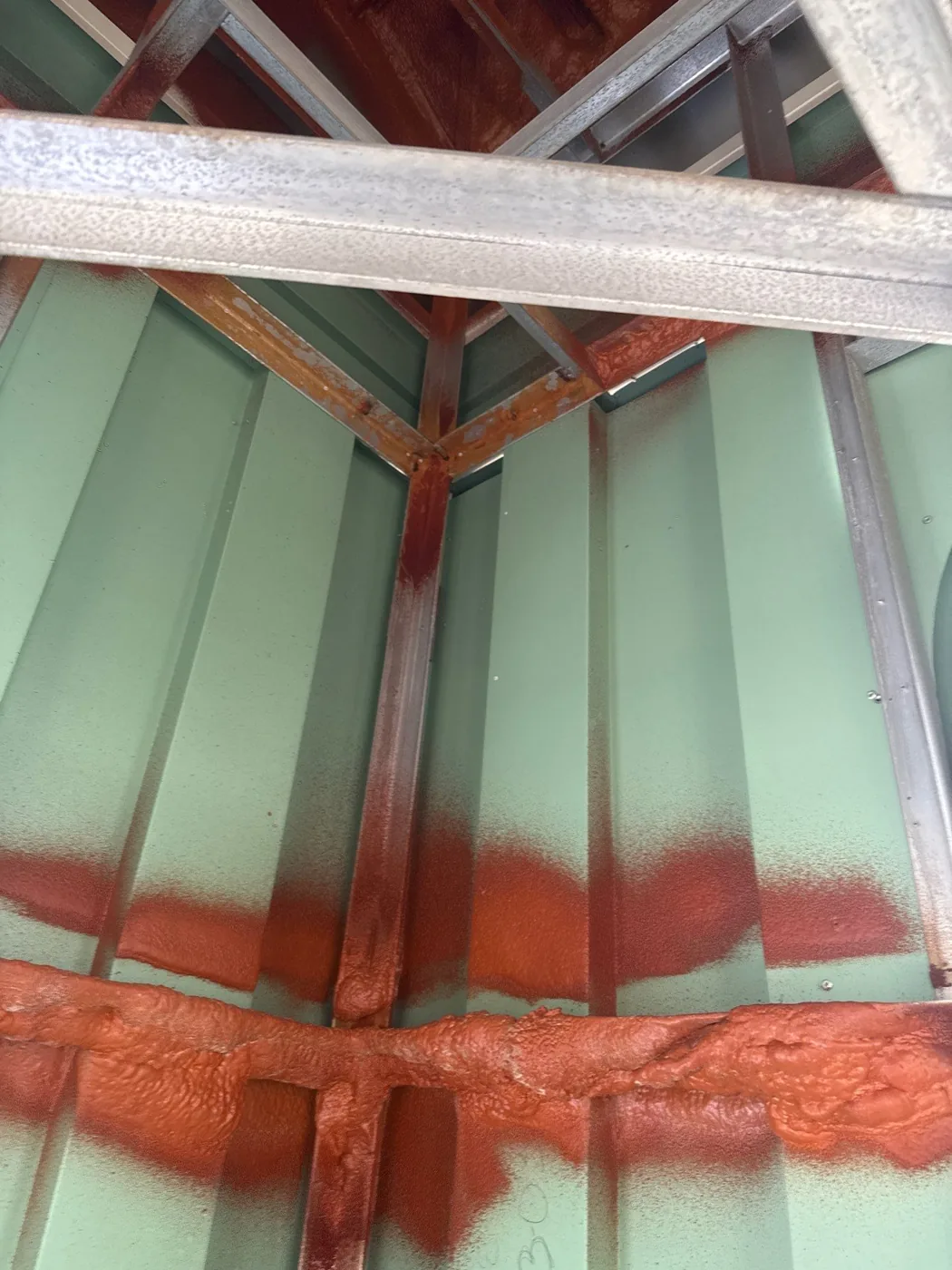
    Inside the belfry, every corroded seam and joint is marked in orange during the inspection so nothing is missed once repairs begin.

    Our church steeple services

    One contractor for the steeple from the base joint to the cross — inspection, repair, restoration, cleaning and, when it comes to that, replacement.

    Steeple inspection & assessment

    A close inspection from a lift or off the sanctuary roof, inside and out: base joint, deck and curb, flashing at every stage, louvers, cladding, the frame inside the belfry, the cross or finial, and lightning protection. You get photographs and a written scope that separates urgent work from planned work. Ask about our free 27-point Church Steeple Inspection.

    Leak repair, flashing & waterproofing

    Resealing and reflashing the steeple base and every stage transition, custom-fabricated flashing where the original is gone, and louver repair so wind-driven rain stays out of the tower.

    Deck sealing & recoating at the steeple base

    Many steeples sit on a small flat deck with a steel curb. We treat the rust, seal the joints, and recoat the deck into one continuous surface draining to its drain — the same low-slope discipline we use on commercial roofs, applied at height.

    Structural reinforcement & framing repair

    Repair and reinforcement of rotted or corroded framing, base plates and anchors inside the steeple and at its connection to the building, so the structure carries its load and its wind as designed.

    Cladding, trim & ornamental restoration

    Repair or replacement of siding, panels and trim — including recladding — and recreation of decorative elements, crosses and finials in materials that match the original look.

    Cleaning & refinishing

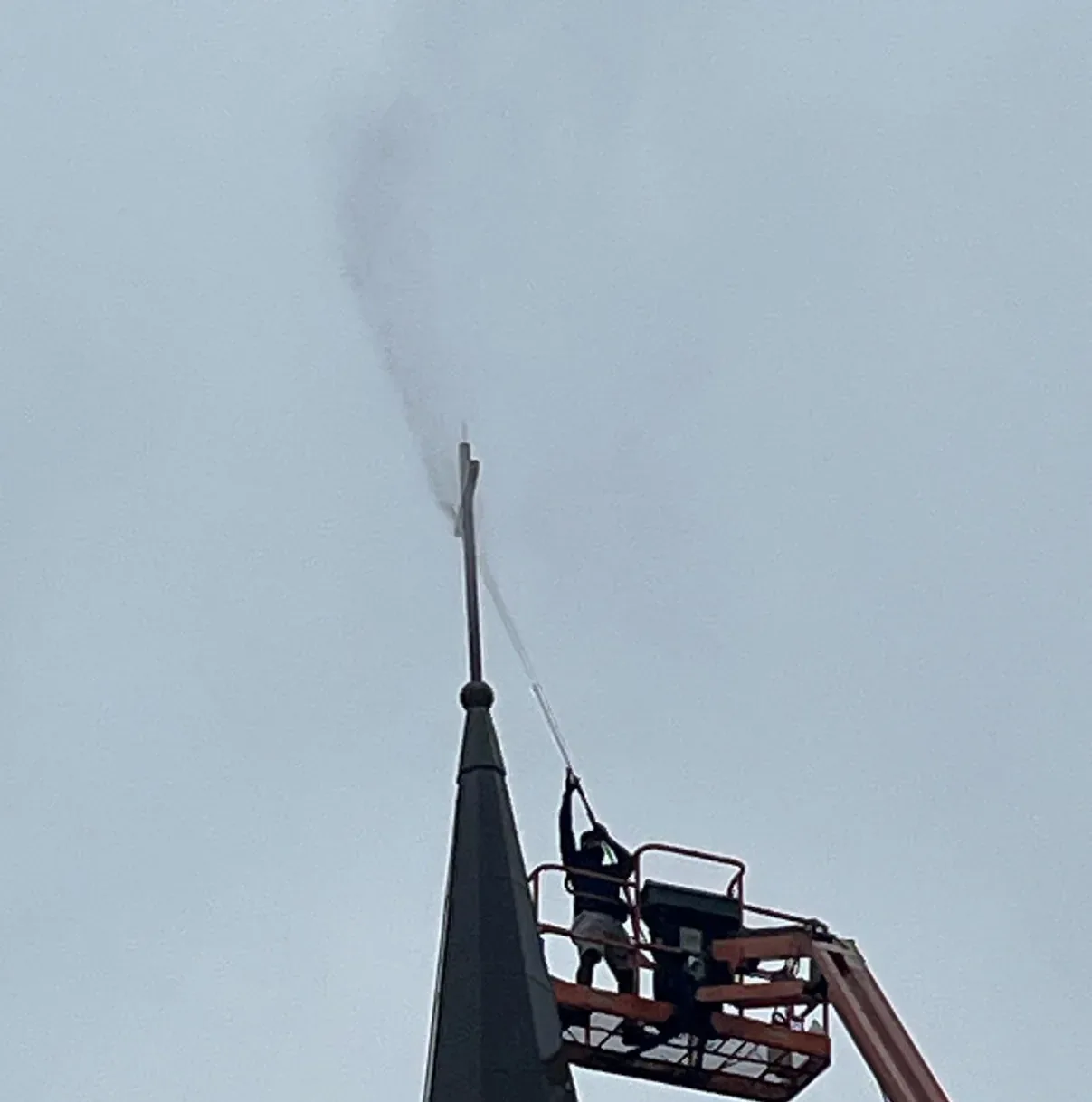
    Pressure-washing the steeple from a boom lift basket all the way to the finial, then refinishing where the surface calls for it. Done after the structure and the base are sound, not instead of fixing them.

    Lightning protection

    Modern lightning protection systems that integrate with historical architecture, certified to UL standards and NFPA 780 compliance, with conductors run to suit the look of the building.

    Crane-set removal, reinstallation & replacement

    When the base under a steeple has to be rebuilt, or the steeple itself is past saving, it comes off by crane. The base is repaired and made watertight while it is open, and the original steeple — or a new one — is set back and secured.

    24/7 emergency leak stoppage

    Steeple work is a high-demand specialty service that requires consultation and scheduling, so the work itself is booked out. What we can do quickly is emergency leak stoppage: covering open seams to stop the water and photographing the damage for the insurance claim. Call (252) 302-2003 day or night.

    Repair, restore or replace: how we decide

    Repair fixes a specific failure: a leaking base joint, a split louver, a loose panel, a cross knocked out of plumb by a storm. Most steeple calls end here, and a repair caught early is the cheapest steeple work there is.

    Restoration brings the whole steeple back to sound condition while keeping its original structure and appearance. Framing repaired, flashing and joints renewed, the deck at the base recoated, cladding and trim restored, the exterior cleaned to the tip of the spire. On a historic church, restoration is almost always the right answer, and like-for-like materials keep the building’s character — and its eligibility for any historic designation — intact.

    Replacement is for a steeple whose structure is too far gone to save, or whose base has to be rebuilt from underneath. The steeple is rigged and lifted off by crane, the base is repaired and made watertight while it is open, and the original steeple after repair — or a new one, often prefabricated — is set back and secured. It is a bigger day, but it is also the only way to fix the part of a steeple the steeple itself covers.

    We make the call from evidence — photographs from inside the belfry and at the base, and probing of the framing — and we show the church board that evidence either way. We would rather restore a steeple than replace it, and we will tell you plainly when restoration would be money spent on a structure that cannot be saved.
    Getting up there: ladders, lifts and cranes

    Access is half of any steeple job and a large part of its cost. The lower stages of many steeples can be reached by ladder off the sanctuary roof. Anything higher — the upper belfry, the lantern, the spire, the cross — needs a boom lift, and lifting a steeple off its base needs a crane or a telehandler rigged for the load.

    We plan the access around the building and the congregation: where the equipment can stand without blocking entrances, what the ground will carry, when the work can happen around services, and which days the wind will allow it. Work at steeple height stops when the wind picks up, so every schedule we give a church has weather in it.

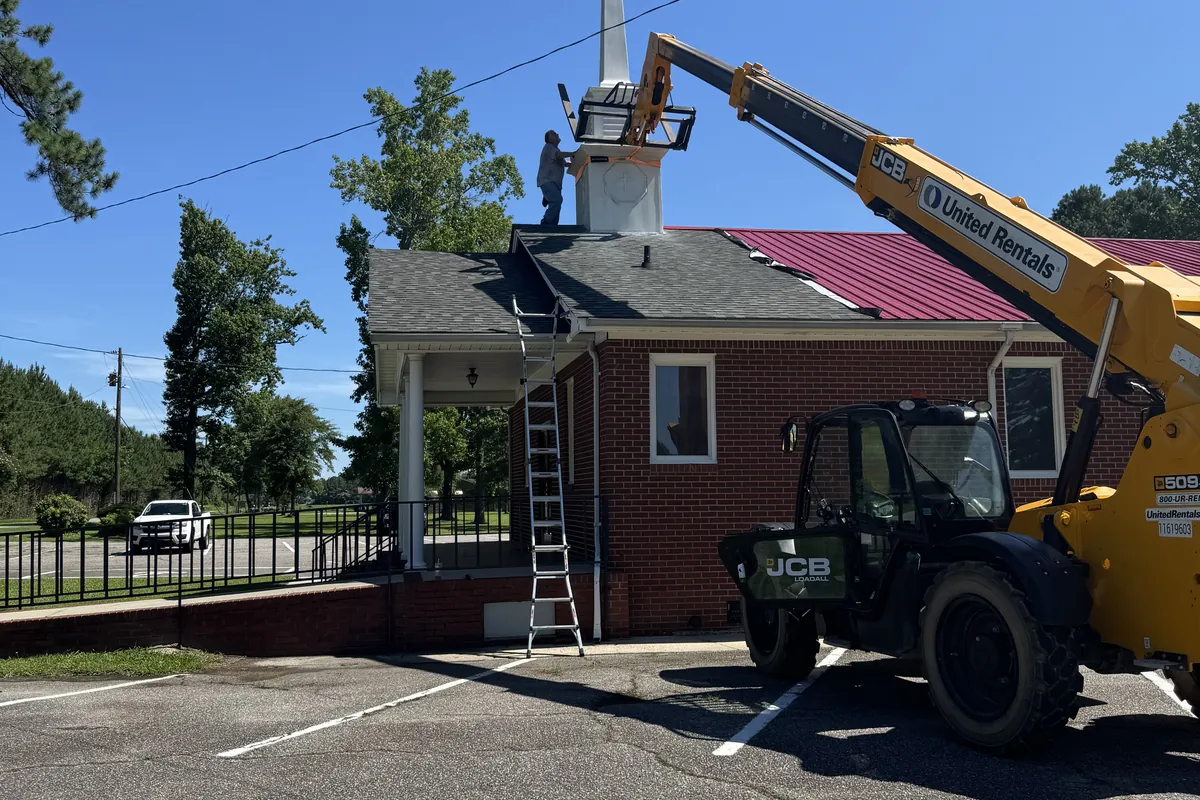
    A telehandler with its boom extended to a white steeple on a small brick church with a red metal and shingle roof, a crew member on the roof beside the steeple
    Access decides the job. Here a rented telehandler reaches the steeple from the parking lot while the church stays open around the work.
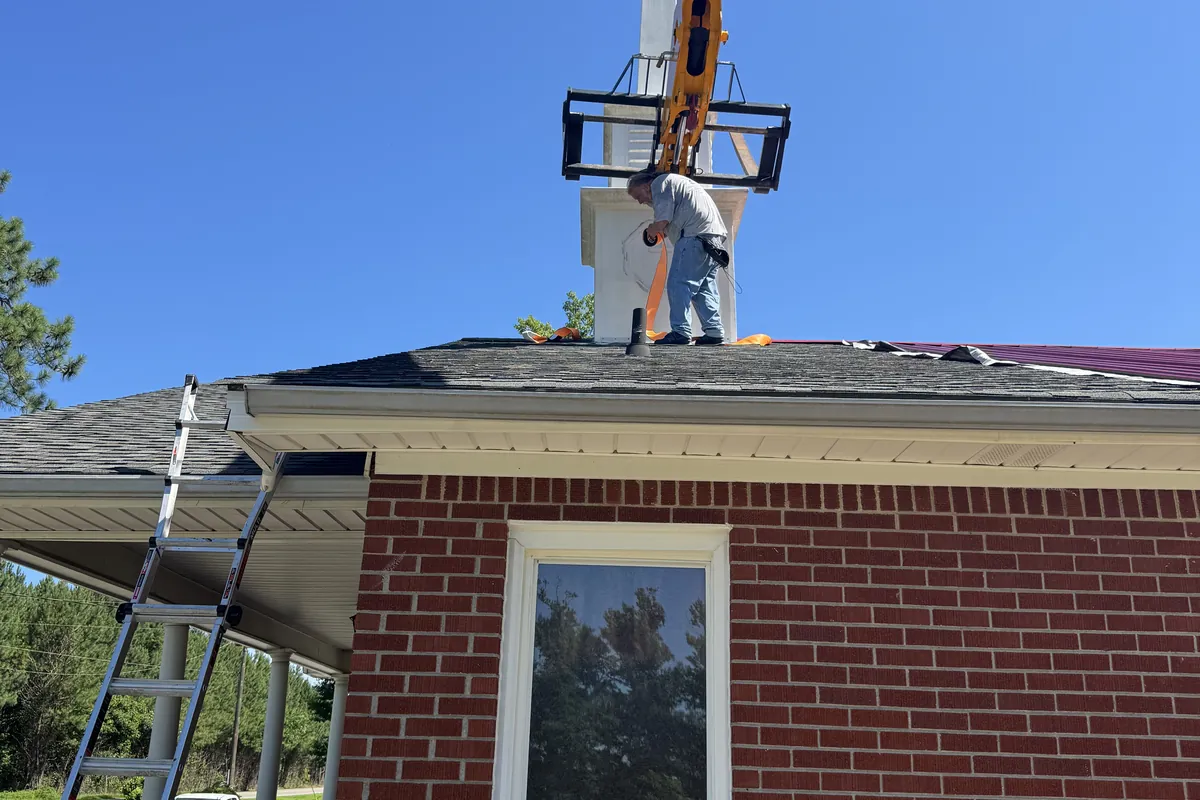
    A crew member on a church roof working at the base of a steeple held by a lift boom and fork frame, ladder against the eave and brick wall below
    The base of the steeple, reachable only while the steeple is lifted. Rot, rust and failed flashing hide here, under the structure, where no ground-level look will ever find them.
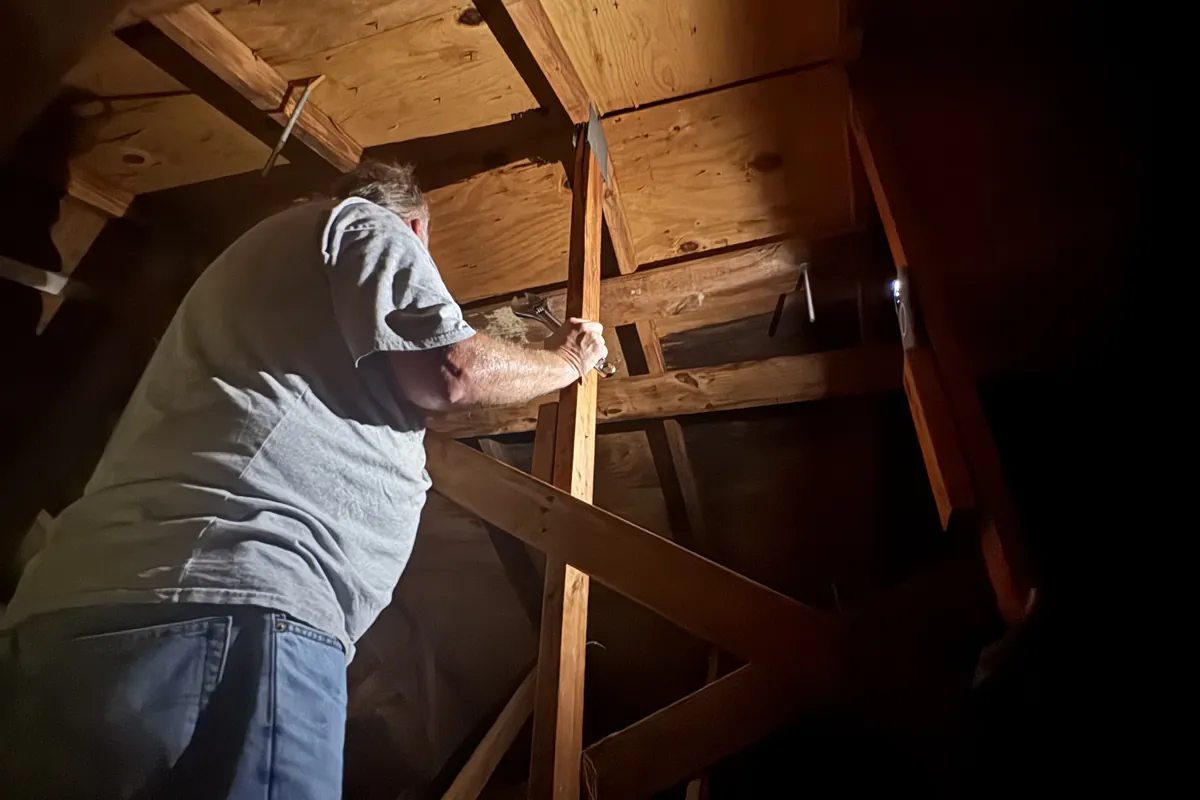
    A crew member with a wrench tightening hardware on the timber framing inside a steeple, lit by a work light
    Inside the steeple, where the framing that carries the whole structure is exposed. This is where a steeple is judged sound or not.
    A worker in a raised boom lift basket beside the upper spire of a steeple, pressure-washing the finial at its tip
    Cleaning runs to the top of the spire and the finial above it, the part of a steeple that almost never gets touched.

    A steeple restoration, start to finish

    A brick church in Eastern North Carolina with a tall white steeple, and dark water staining running down the brick tower below the belfry. We reached the base by ladder off the sanctuary roof and, later, by a towable boom lift.

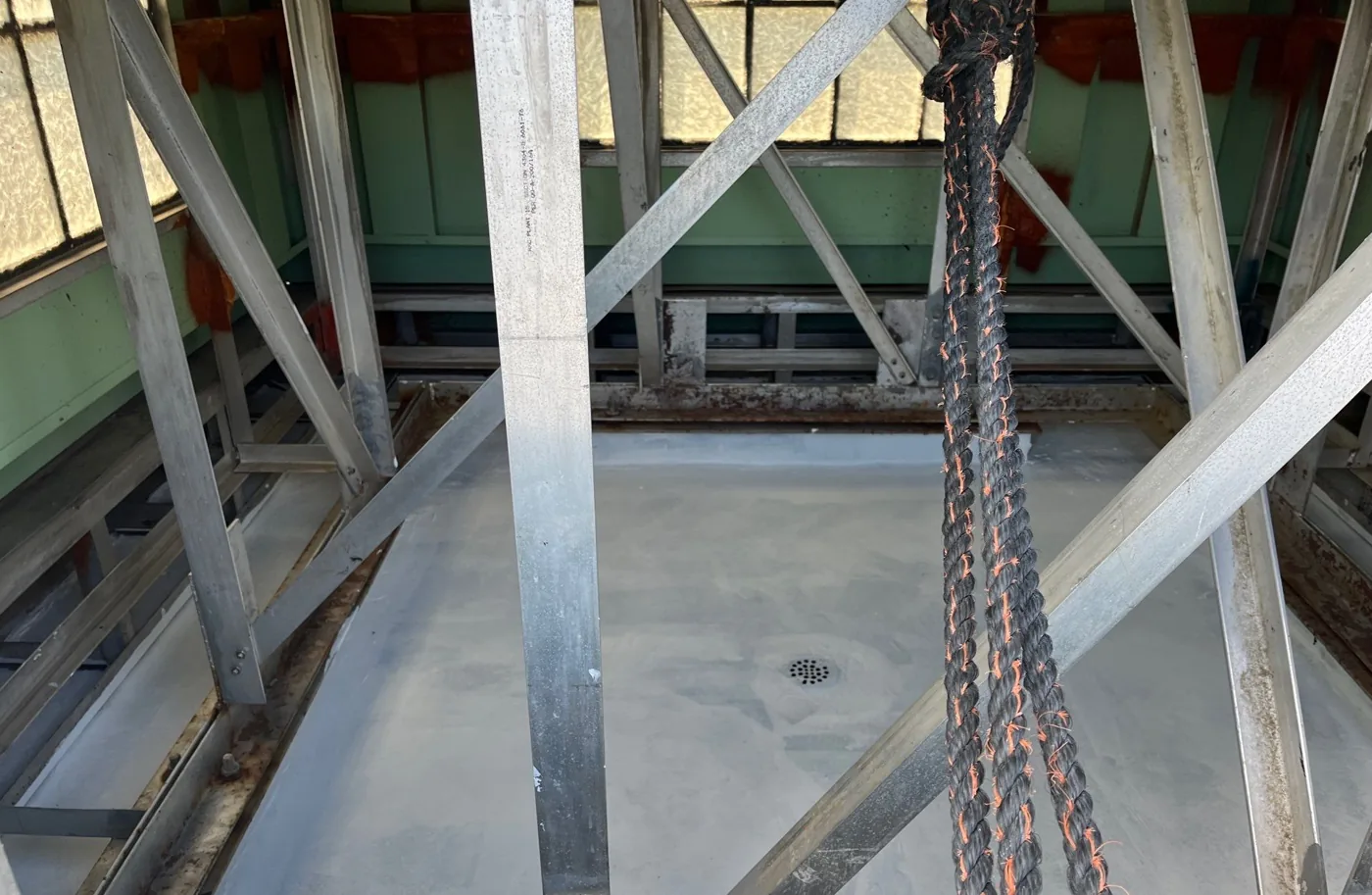
    Inside the louvered belfry, the crew marked every corroded area of the structural frame in orange. On the flat deck at the steeple base, the steel curb had rusted through its coating — the path the water had been taking into the tower. The rust was treated, the joints sealed, and the deck recoated to one clean, continuous surface draining to its centre drain. The job closed out with the exterior pressure-washed from the lift basket, all the way up to the finial.

    See the full photographed steeple restoration — ten photos from the first look to the finished spire.

    The flat deck at the base of a church steeple after recoating, a clean uniform light grey surface draining to a centre drain, the belfry frame above
    The deck at the steeple base after the rusted curb was treated, the joints sealed and the surface recoated: one continuous surface draining to the centre drain.

    Our 6-step church steeple restoration process

    A systematic approach that respects both the structure and its history.

    1. 1

      Reverent assessment

      We start with a thorough, respectful evaluation of the steeple with church leadership: what is damaged, what is historic, what the structure is doing, and what the congregation’s priorities and budget are. Access is by ladder off the sanctuary roof or by lift, because a steeple cannot be judged from the ground.

    2. 2

      A written plan the board can act on

      Unlike a standard roofing job, a steeple needs a tailored plan. Ours separates what must be done now — water entry, structural corrosion, storm damage — from what can be scheduled, and picks materials that match the steeple’s original appearance while giving modern protection.

    3. 3

      Material sourcing & preparation

      Historically appropriate materials that match the original components, from specialist suppliers of architectural preservation materials where the building calls for it, and premium roofing products from manufacturers including GAF, CertainTeed and Owens Corning where modern materials are the right answer.

    4. 4

      Skilled craftsmanship at height

      Our steeple specialists combine traditional woodworking with modern weatherproofing. Our master craftsmen are certified in heritage skills including traditional joinery techniques, hand-tool woodworking, and historic finishing methods. The work is scheduled around services so the sanctuary stays usable.

    5. 5

      Weather protection for Eastern NC

      Every detail is built for this region: wind that is stronger at steeple height, rain driven sideways by summer storms and tropical systems, and a long season of sun working on finishes and sealants.

    6. 6

      Final inspection & documentation

      We walk the finished work with church leadership and hand over documentation of what was done — before-and-after photographs, material specifications and a maintenance schedule — so the next building committee knows exactly what it has.

    Wood, metal, copper, slate and fiberglass steeples

    Every steeple material fails in its own way, and the repair has to suit the material.

    Wood-framed, painted steeples

    The classic Eastern NC steeple: wood framing clad in wood or composite siding and trim, painted white. Strength depends entirely on keeping water out of the framing, so the work is flashing, sealant, rot repair and paint in that order.

    Metal-clad spires and belfry frames

    Many steeples carry a metal-clad spire, and many newer ones stand on a metal frame inside the belfry. Corrosion at seams, joints and fasteners is the enemy; treatment and recoating before rust takes section out of a member is the goal.

    Copper

    Copper spires and roofs last a very long time, and the failures are usually at seams, fasteners and the connection to other materials rather than the copper itself. Repairs are made in kind.

    Slate

    Slate-clad spires and towers fail fastener by fastener and slate by slate. Like-for-like repair is almost always possible and almost always the right answer on a historic building. Our historic slate roof repair page covers slate in detail.

    Fiberglass

    Prefabricated fiberglass steeples are common on newer churches and as replacements. They do not rot, but they crack, their joints and fasteners loosen, and their bases and connections leak like any other steeple. Fiberglass steeple repair is sealing, patching and securing — and setting by crane when one is replaced.

    Slate on the tower or the sanctuary? Our historic slate roof repair page goes deeper.

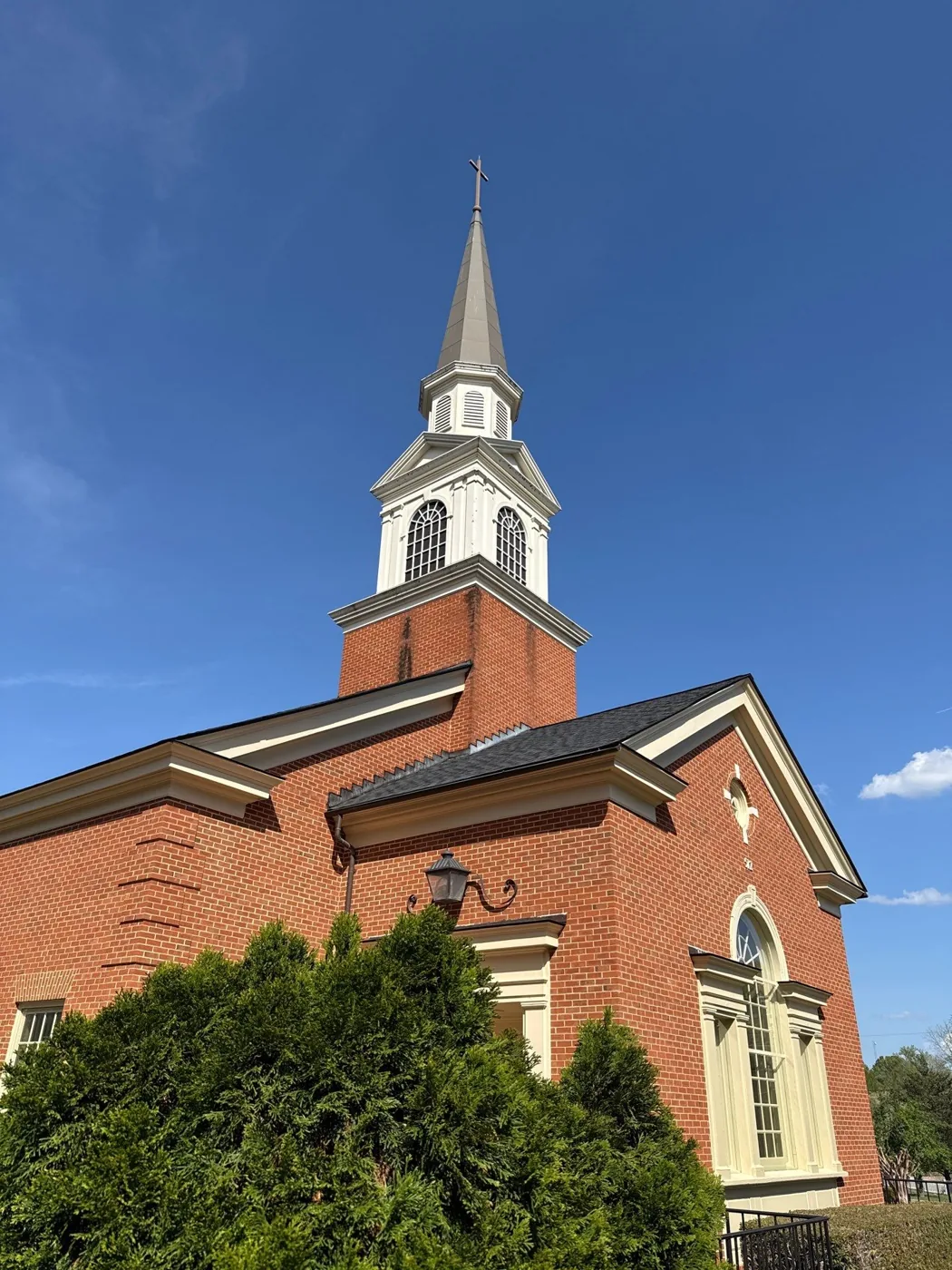
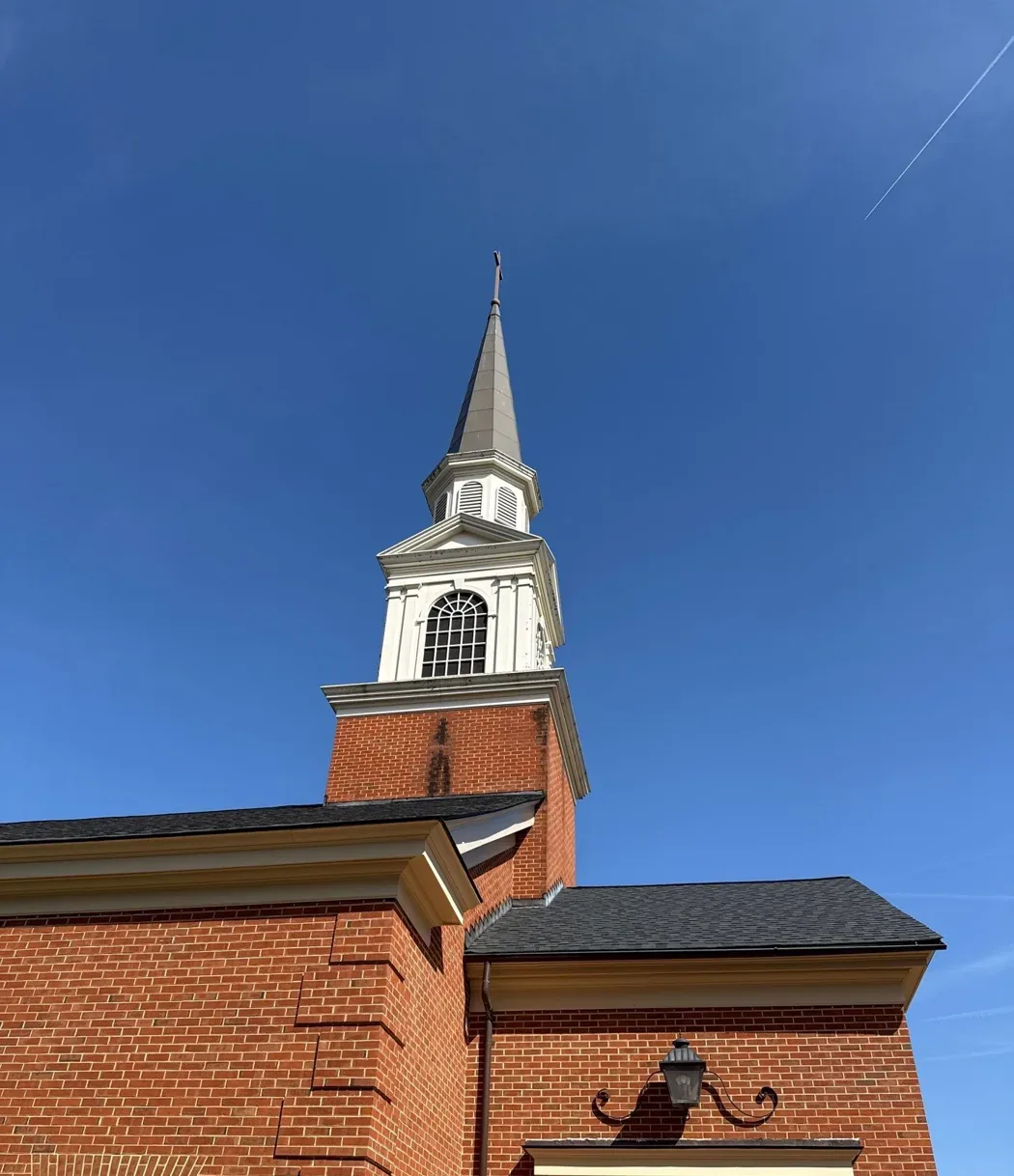
    A brick church with a white belfry, louvered lantern and tall grey spire topped by a cross against a deep blue sky
    A typical Eastern NC steeple: brick tower, painted wood or composite belfry and lantern, and a metal-clad spire — four materials, dozens of joints, all of them above the reach of a ladder.

    For pastors, trustees and building committees

    Budgeting. A steeple budget is decided by access, height, material and how far water has travelled into the structure. The inspection is how a board stops guessing: it separates the work that protects the building now from the work that can be planned into next year’s budget.

    Scheduling around worship. We plan loud work, lifts and crane days around services, weddings and funerals, and keep entrances and parking usable. The sanctuary stays in use through almost all steeple work.

    Insurance. Sudden damage from wind, lightning or a falling limb is often covered by a church property policy; gradual deterioration usually is not. After a storm we photograph and document the damage, write the scope, and meet the adjuster on site. Our North Carolina roof insurance claims guide walks through notice, the adjuster visit, deductibles and depreciation, and our storm damage page covers what to do in the first days.

    The rest of the building. Steeple work often turns up problems in the sanctuary and education-wing roofs below. We handle those too — see our commercial roofing, roof repair and roof replacement pages.

    Where we repair steeples

    From our offices in Rocky Mount and Greenville we serve churches across Eastern North Carolina and into the Triangle, including Rocky Mount, Greenville, Wilson, Tarboro, Goldsboro, New Bern and Raleigh. Steeple work travels further than roofing does — if your church is in North Carolina and the steeple needs attention, call and ask.

    Church steeple repair: frequently asked questions

    What does church steeple repair in Eastern North Carolina involve?

    It starts with an inspection from a lift or by ladder off the sanctuary roof, because most steeple problems — failed flashing at the base, rusted steel, split sealant joints, loose cladding, corroded framing inside the belfry — cannot be judged from the ground. From that inspection Carolina Trophy Roofs writes a scope that separates what must be fixed now (water entry, structural corrosion, storm damage) from what can be planned. The work itself ranges from resealing and reflashing the steeple base and recoating the deck around it to replacing cladding, rebuilding rotted framing, cleaning and refinishing the spire, and reinstalling the cross or finial.

    What is the difference between steeple repair, restoration and replacement?

    Repair fixes a specific failure — a leaking base joint, a loose panel, a storm-damaged cross. Restoration brings the whole steeple back to sound condition while keeping its original structure and appearance: framing repaired, joints resealed, decks recoated, cladding and trim refinished, the exterior cleaned to the tip of the spire. Replacement means the old steeple comes off by crane and a new one is set on a prepared base. We recommend replacement only when the structure itself is too far gone to save, and we show the church board the evidence from the inspection either way.

    How much does it cost to repair a church steeple?

    There is no honest flat figure. The price is driven by height and access (whether a boom lift or crane is needed, and for how long), the material of the steeple (wood, copper, slate, fiberglass or metal), how much of the structure has been reached by water, and whether the church is a designated historic property that requires like-for-like materials. Carolina Trophy Roofs inspects the steeple first and quotes the actual scope, so the church board sees the price of the work that is really there.

    Can you remove a steeple and set it back, or set a new one?

    Yes. Crane-set steeple removal and reinstallation is part of our steeple work. The steeple is rigged and lifted off, the base it sits on is repaired, reflashed and made watertight while it is open, and the steeple — the original after repair, or a new one — is set back by crane and secured. It is the only way to properly repair a rotted or rusted base that the steeple itself covers.

    What are the most common steeple problems you find?

    Water infiltration at the base joint and around the belfry louvers, deteriorated or missing flashing, corrosion of the steel curb, base plate and anchors, rot in the wooden framing behind the cladding, wind damage to cladding and the cross or finial, and failed or missing lightning protection. Eastern North Carolina steeples take more weather than the roof below them: they sit higher in the wind and shed rain across many joints, so the same storm that leaves a roof intact can open a steeple seam. Dark streaks running down the brick tower below the belfry are the most common outward sign that water is getting in above.

    How long does a steeple repair take?

    A resealing and reflashing job at the base is usually finished in days. Rebuilding framing, replacing cladding or refinishing a spire takes longer because custom-fabricated pieces have to be made and the lift or crane has to be scheduled around the weather. Carolina Trophy Roofs gives the church a written schedule after the inspection and plans intensive work around services so the sanctuary stays usable.

    Do you clean and refinish steeples?

    Yes. We pressure-wash steeples from a boom lift basket, all the way up the spire to the finial — the part of a steeple that almost never gets touched because so few roofers will go up there. Cleaning is also the first step of any refinish or recoat, because nothing bonds to chalk, mildew and grime. We do it after the structure and the deck at the base are sound, so the clean finish is not undone by the next rain finding the same leak.

    Do you handle emergency steeple repairs after a storm?

    We can do emergency leak stoppage. Carolina Trophy Roofs runs a 24/7 emergency line at (252) 302-2003 from offices in Rocky Mount and Greenville, and after a storm the first job is to stop water entering — covering open seams and photographing the damage while it is fresh. The steeple work itself is a high-demand specialty service that requires consultation and scheduling, so it is booked out; the repair plan and the insurance documentation follow from that consultation.

    Does church insurance cover steeple repair?

    That depends on the cause and on the policy. Church property policies commonly cover sudden damage from named perils such as wind, lightning or falling objects, and commonly exclude gradual deterioration and deferred maintenance. Carolina Trophy Roofs documents storm damage with dated photographs and a written scope, meets the adjuster on site, and handles the claim paperwork; the coverage decision itself rests with the carrier and the policy. Our roof insurance claims guide explains the North Carolina process step by step.

    How often should a church steeple be inspected?

    Have it looked at on a regular schedule and after any severe storm, and do not wait for a leak in the sanctuary to call. Steeple damage is almost always found late because nobody can see the base joint, the belfry framing or the upper spire from the parking lot. A periodic inspection from a lift catches split sealant and early rust while the fix is still sealant and coating, not framing and a crane.

    Why do churches have steeples?

    A steeple is the tall tower-and-spire structure rising above a church, and historically it did practical work as well as symbolic work: it housed the bell, made the church visible and findable from a distance, and pointed the eye upward. That height is exactly what makes steeples hard to maintain — they take the full force of wind, rain and lightning, and they are the part of the building hardest to reach. Keeping one sound is specialist work that most roofing companies will not take on.

    Is your church steeple showing the warning signs?

    Staining down the tower, a ceiling stain under the steeple, a loose panel or a cross out of plumb — request our free 27-point Church Steeple Inspection and find the problem while it is still a sealant-and-coating repair.

    Continue Exploring

    conversion

    Contact Us

    contact us for a free estimate

    conversion

    Book Free Inspection

    book your free inspection

    contextual

    Storm Damage Repair

    Need emergency storm damage repair?