Rocky Mount, NCEastern North Carolina

    Commercial RoofingRocky Mount & Eastern North Carolina

    Our office is on S. Business Ct in Rocky Mount, which makes this our home market — the roofs we drive past every day. We install, restore and maintain low-slope commercial roofing for businesses, property managers and congregations from Rocky Mount and Wilson out through Greenville, over to Garner and the Raleigh suburbs, and down east toward the coast.

    Workmanship that lasts, priced fairly by a local company — and a phone that gets answered at 2 a.m. when water is coming in over your inventory.

    A Rocky Mount company, working across Eastern NC

    Commercial roofing is a relationship trade. The contractor who replaces your roof should be the one inspecting it twice a year afterwards, the one who knows where the drains are because they cleared them last fall, and the one close enough to be on your roof quickly when a storm opens something up. That is the argument for hiring local, and we are about as local as it gets: our office is in Rocky Mount, and the commercial buildings of Nash and Edgecombe counties are our home turf. Recent jobs there, including a flat roof re-covered in metal, are on our Rocky Mount commercial roofing page.

    From there the service area runs the breadth of Eastern North Carolina: Wilson and Greenville with their medical, institutional and industrial buildings; Garner and the fast-growing retail and warehouse corridors of the Raleigh-area suburbs; and down east toward the coast, from New Bern to the smaller towns where a lot of good commercial buildings have spent years without a serious roofer nearby. Same crews, same standards, wherever the building is.

    Being based here also means we build for this climate on purpose: long humid summers that punish dark roofs and reward reflective ones, hard thunderstorms that find every marginal seam, and the occasional tropical system that tests every edge termination on the building. None of that is theoretical to us — we live under the same weather.

    Low-slope roofing systems, and when each one earns its place

    There is no single best commercial roof — there is the right system for a particular deck, budget, and building use. These are the systems we install and service every week, described the way we would explain them across a table, not the way a brochure would.

    TPO — heat-welded single-ply

    TPO is the white reflective membrane on most new commercial roofs in this region, and for defensible reasons. Its seams are not glued — they are heat-welded with hot air, which fuses the sheets into a single monolithic layer. A properly welded and probe-tested seam is as strong as the membrane on either side of it, which is exactly what you want on a roof whose whole job is keeping seams closed. The white surface reflects summer sun instead of soaking it in, which matters over a conditioned building in an Eastern NC July. Where TPO jobs actually succeed or fail is at the details: the flashing around HVAC curbs, pipe penetrations and parapet terminations. That is hand work, and it is where experienced crews separate themselves.

    EPDM — the proven rubber roof

    EPDM is synthetic rubber, and it has been protecting American commercial buildings for decades — long enough that its aging behavior is not a guess. It goes down fully adhered, glued to the substrate across its whole area, or ballasted under washed stone; fully adhered is what we recommend on most occupied buildings here because of the wind we get. EPDM seams are joined with seam tape and primer rather than a weld, so the seam prep — clean, primed, rolled — is the craftsmanship of the system. Its virtues are simplicity and repairability: an EPDM roof that gets honest maintenance can be patched and kept serviceable for a very long time, which is why so many warehouse owners stay loyal to it.

    Modified bitumen — multi-ply redundancy

    Modified bitumen is asphalt reinforced with polyester or fiberglass and built up in plies, with a granulated cap sheet on top. Where single-ply systems put one membrane between the weather and your inventory, mod-bit puts several — redundancy that pays for itself on roofs that see regular foot traffic from HVAC techs and other trades, because the surface takes abuse that would gouge a single-ply. It can be torch-applied, cold-process or self-adhered depending on what the building and its occupants can tolerate; on an occupied building we lean toward the flame-free methods. It remains our answer for high-traffic roofs and complicated roofscapes crowded with equipment.

    Metal panel systems and retrofits

    Eastern North Carolina is full of metal-roofed commercial and agricultural buildings, and the failure pattern on the older screw-down ones is predictable: thousands of gasketed fasteners, each backing out a little as the panels expand and contract through our temperature swings, each becoming a small leak. We install standing seam systems, whose concealed clips take the movement problem away, and we retrofit aging screw-down roofs — re-securing panels, replacing fasteners, and in many cases restoring the whole roof with a seam-sealing coating system instead of tearing it off. Which route makes sense depends on the condition of the panels themselves, and that is an inspection question, not a brochure question.

    Coating and restoration — the alternative to tear-off

    Not every aging commercial roof needs to come off. If the insulation below is dry and the membrane is fundamentally sound, a fluid-applied restoration — repairs first, then a silicone or acrylic coating over the prepared field — turns the existing roof into the substrate for a new seamless, reflective membrane. The business case is straightforward: no tear-off means no dumpsters, far less disruption to the building underneath, no days where the deck is open to the sky, and a renewable surface that can be recoated when it ages. It is honest to say coatings are not for every roof — a saturated roof needs the wet material out, full stop. When it fits, though, it is often the best value on this page, and we wrote a full page on it.

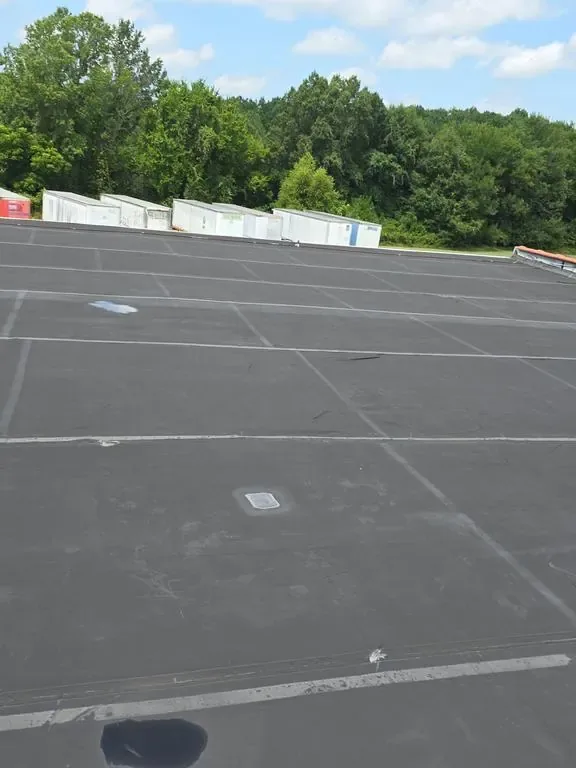
    Dark EPDM rubber membrane field across a large commercial roof in Eastern North Carolina
    An EPDM field doing its job: the membrane is simple, which is exactly its virtue — fewer things to fail.
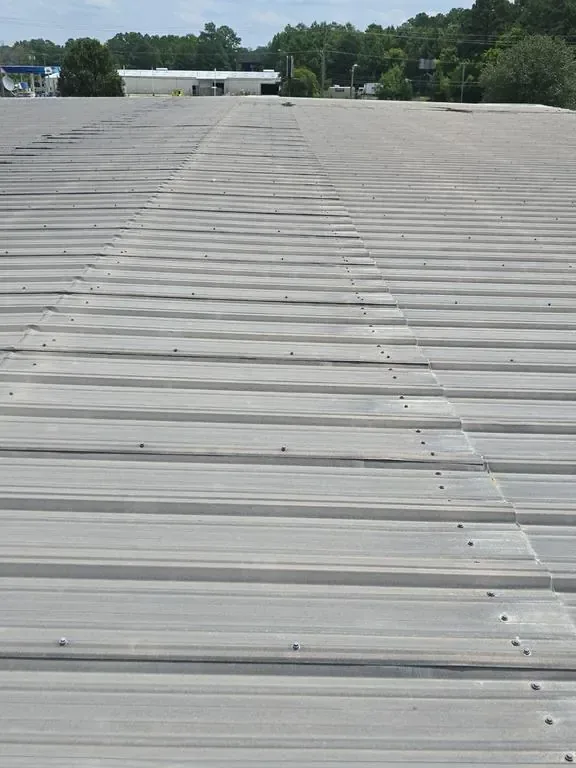
    Corrugated metal commercial roof viewed down the panel ribs before retrofit work
    A screw-down metal roof due for fastener service — the panels outlast the gaskets, which is why the maintenance interval matters.
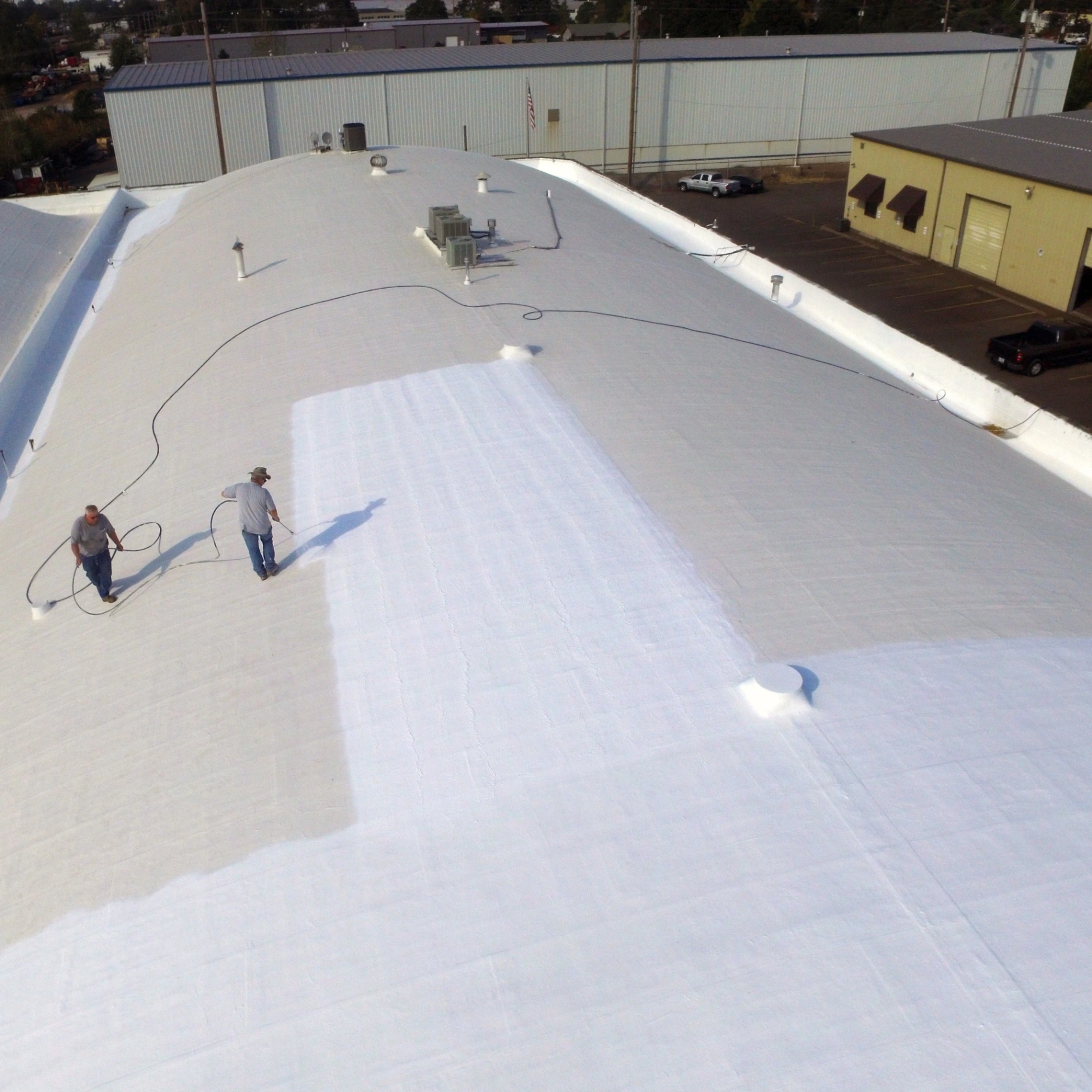
    Aerial view of a large low-slope commercial roof in an industrial park being spray-coated with a white reflective roof coating, two applicators working across the field with spray lines
    A fluid-applied reflective coating going down across a large low-slope roof. The bright white area is the finished membrane; the crew works the field in passes, sealing the whole surface — penetrations, curbs and all — into one continuous waterproof layer without a tear-off.

    If the restoration route interests you — and for a sound roof it should — the full explanation of surface prep, silicone versus acrylic, and which roofs qualify is on our roof coating and restoration page.

    The buildings we roof

    Every commercial building type fails differently and tolerates work differently. Here is what we actually do for each, including the one almost nobody else in Eastern NC will take on.

    Retail and storefront

    Strip centers, standalone stores and restaurants — usually low-slope roofs hidden behind a parapet, with the customers who keep you in business parked directly below the work. We stage and cordon so the storefront stays open and the sidewalk stays safe, schedule the loudest phases around your hours, and keep the lot clean enough at the end of each day that nobody shopping there knows a roofing project is on.

    Offices and professional buildings

    Occupied office buildings are scheduling problems as much as roofing problems: adhesive odors, rooftop noise over someone mid-meeting, HVAC curbs that have to be flashed while the units keep conditioning the floors below. We plan those sequences with your building manager before anyone is on the roof, and we put them in writing.

    Warehouses and light industrial

    Big fields of roof over inventory and operations that cannot pause for us. Warehouse work is won on logistics — protecting racked stock beneath the deck, working around dock schedules, and handling skylights and translucent panels that are usually the most fragile, most leak-prone things up there. Large simple roofs also make the strongest case for the maintenance programs and restoration coatings described below.

    Churches and institutional buildings — including the steeple

    Churches are commercial-scale buildings maintained by volunteers and building committees, and they combine nearly every roofing challenge on this page: steep sanctuary roofs beside low-slope education wings, decades of accumulated patchwork, and budgets that answer to a congregation. We do this work regularly across Eastern NC, and we are comfortable presenting findings to a building committee in plain language, with photographs of everything we are describing.

    Then there is the steeple — the part of the building most roofers will not touch. We will. Our crews handle crane-set steeple removal and reinstallation, structural inspection inside the belfry where the frame that carries the whole structure is exposed, sealing and recoating the flat decks at the steeple base where rusted curbs let water into the masonry below, and pressure-washing spires from a boom lift right up to the finial. The details live on our church steeple repair page, and you can walk through a complete photographed steeple restoration project from an Eastern NC brick church, start to finish.

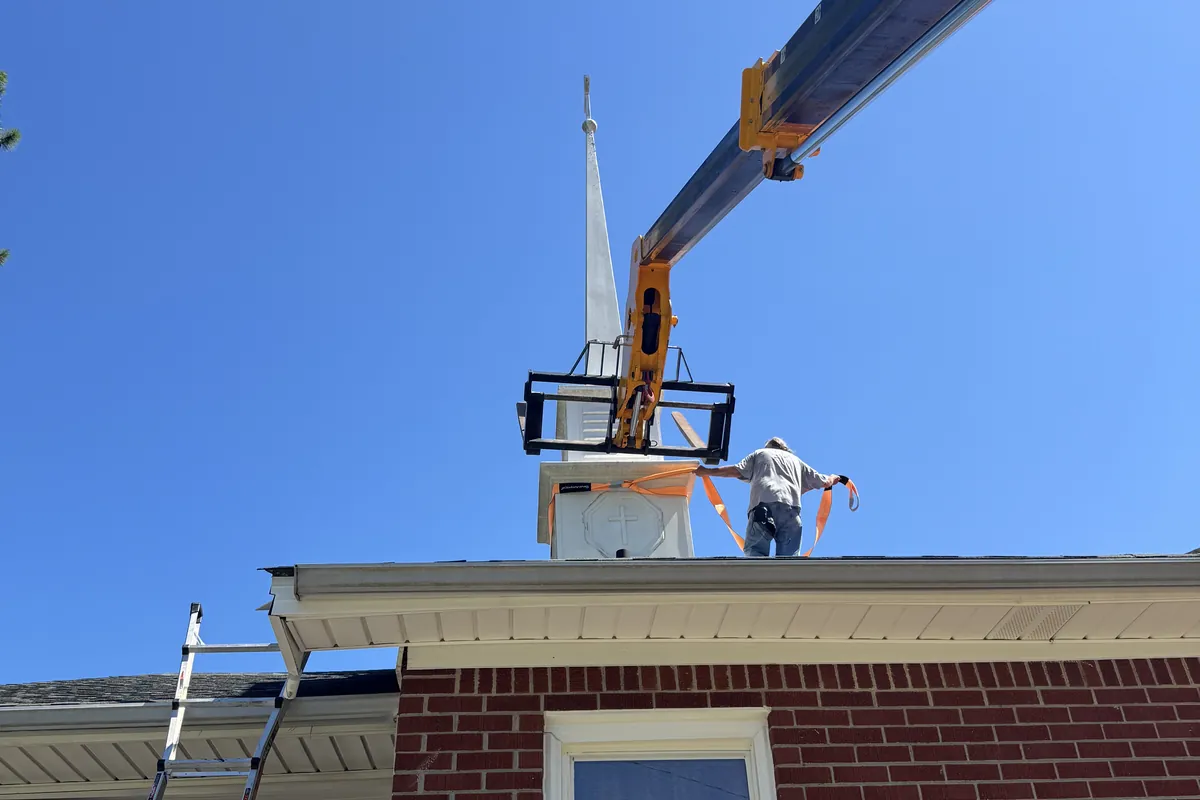
    A white church steeple with a tall spire being set onto the roof of a brick church by crane, with a crew member on the shingle roof guiding it into place with rigging straps
    Setting a steeple back on a brick church in Eastern North Carolina. Work like this takes crane rigging, a crew comfortable at height, and coordination with the congregation — it is a small fraternity of roofers who will take it on at all.
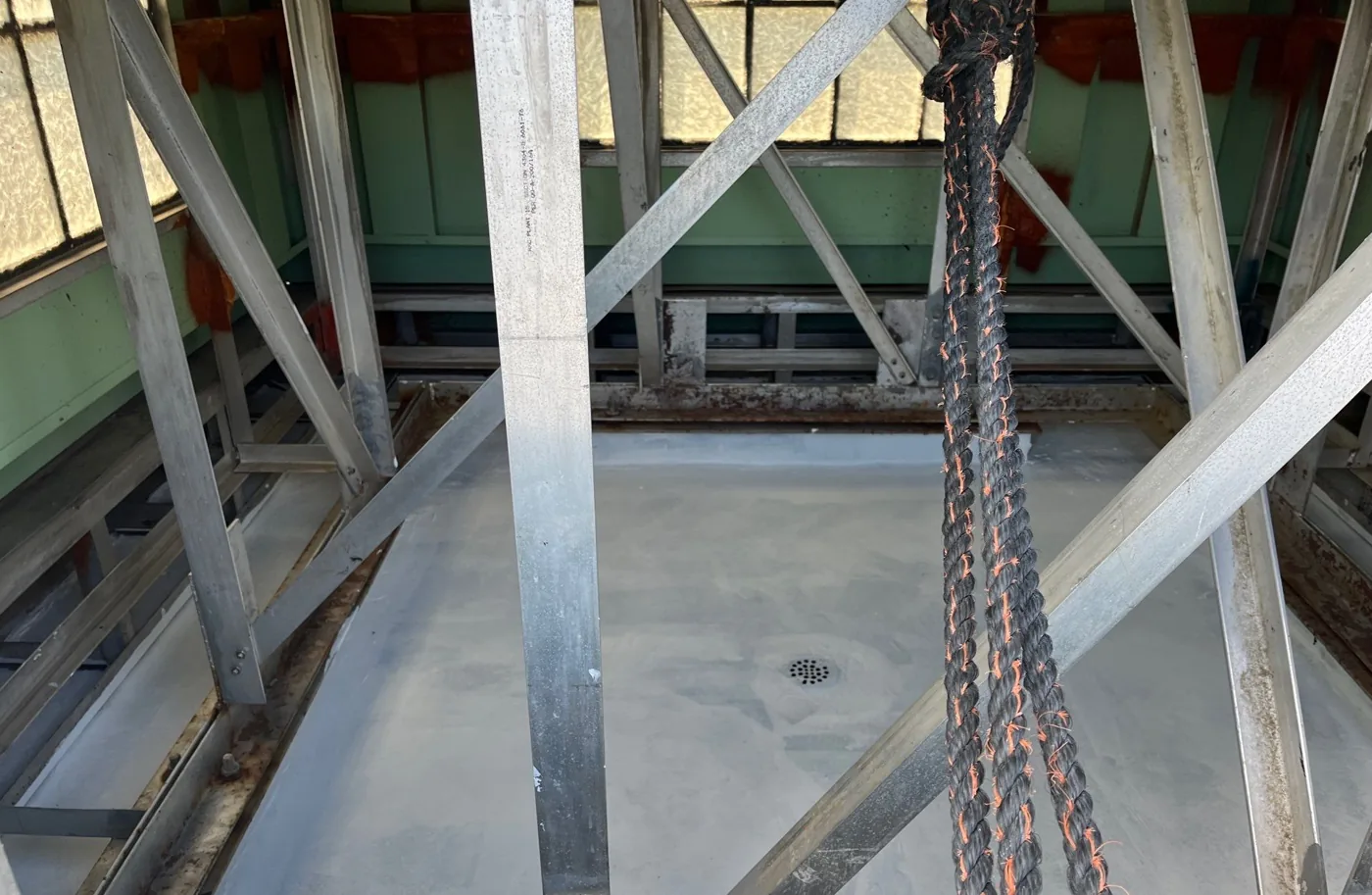
    The flat deck at the base of a church steeple after recoating, showing a clean, uniform light grey surface draining to a center drain, with the aluminum belfry frame above
    The flat deck at the base of a steeple after sealing and recoating — the same low-slope waterproofing discipline we bring to any commercial roof, applied sixty feet up. Before this, the steel curb here was rusted through and streaking the brick below.

    What a commercial client actually needs from a roofer

    Owners and property managers rarely lose sleep over membrane chemistry. They lose sleep over disruption, liability, and being unable to prove what was done. This is how we handle each.

    Minimal disruption to the business

    Phased sections, early-morning starts, staging kept off your customer parking and clear of your entrances. The building keeps operating; the roof gets replaced around it. The plan for how is agreed with you before the first pallet of material arrives.

    Safety on occupied sites

    An occupied commercial site means your employees, customers and tenants moving under and around our work. Cordoned drop zones, controlled access to the roof, tie-off on the edges, and a site left clean every evening — treated as part of the job, not a courtesy.

    Documentation you can forward

    Property managers and owners answer to other people. Every project and inspection produces a written record with photographs — condition found, work performed, what to watch — that you can attach to an email to an owner, a board or an insurer without translating it first.

    Maintenance programs

    Semi-annual inspections — after winter and after the heat of summer — with drains cleared, sealants touched up, small punctures patched while they are still small, and a dated photo report each visit. Most commercial roof failures announce themselves quietly for years first; a maintenance program is how someone hears it.

    Drainage and ponding correction

    Standing water is the slow killer of low-slope roofs: it degrades membranes, finds every weak seam, and adds real load. We correct it at the cause — clearing and adding drains and scuppers, rebuilding saturated low areas, and using tapered insulation to give a dead-flat roof somewhere for water to go.

    Emergency leak response, 24/7

    When water is coming in over your stock or your server room, you need a roofer who answers the phone. Call (252) 302-2003 any hour. We locate the entry point, get it sealed or tarped, photograph everything for your records and your insurer, and then talk about the permanent fix in daylight.

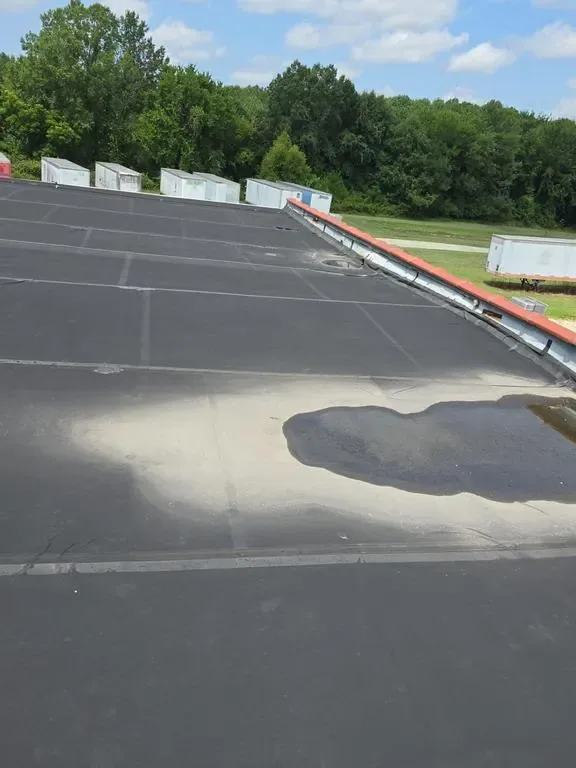
    Ponding stain across a black membrane commercial flat roof beside rooftop HVAC equipment
    The ponding ring tells the story before any moisture meter does: water is standing here 48 hours after rain, and the membrane below it is aging faster than the rest of the roof.
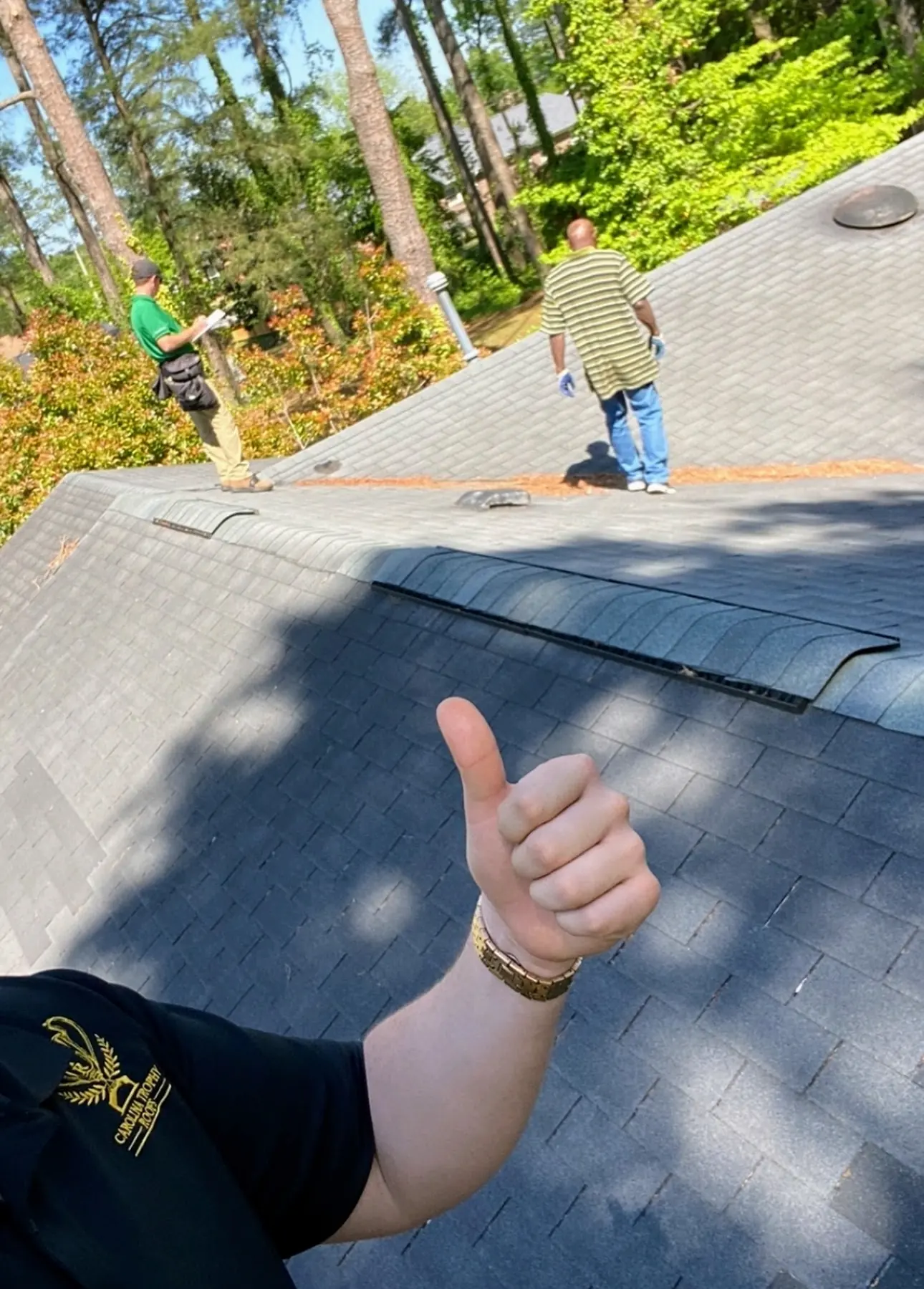
    Carolina Trophy Roofs inspection team on a roof in Eastern North Carolina, one team member taking notes on a clipboard while another walks the far slope
    Our inspection team on a roof in Eastern NC, one of them writing the condition notes on the spot. Every commercial condition report we hand a property manager is built the same way: someone physically on the roof, writing down what is actually there. If you manage property for owners who are not local, that discipline is most of what you are hiring: a report you can forward with confidence, because someone stood on the roof to write it.

    Repair, restore, or replace — an honest framework

    This is the most expensive decision a building owner makes about a roof, and it should be made from evidence, not from whichever option the contractor happens to sell. The evidence is underneath: whether the insulation between the membrane and the deck is dry or wet, and how much of it. We establish that with an inspection and moisture evaluation — checking suspect areas directly rather than guessing from the surface — because a membrane can look tired while the roof under it is perfectly sound, and look fine over insulation that is soaked.

    Repair is the answer when problems are localized — a failed seam, a puncture from a dropped tool, flashing that has pulled away at a curb — and the field of the roof is otherwise healthy. Done promptly and documented, repairs buy sound roofs years of honest service, and a maintenance program exists precisely to catch problems while they are still in this category.

    Restoration — the coating route — is the answer when the surface is aging but the roof beneath is dry: the membrane is weathering, seams need attention everywhere rather than in one spot, but the insulation holds no significant moisture. Repair the details, then seal the whole field under a fluid-applied membrane. It costs meaningfully less than replacement, avoids the disruption of a tear-off entirely, and resets the roof's aging clock.

    Replacement is the answer when the moisture survey says so — wet insulation across substantial areas, a deck with corrosion or rot, or a roof already carrying multiple layers of past work. Coating over a wet roof does not fix it; it hides it, and we will not do it. When replacement is the honest call, we say so, show you the evidence in the report, and plan the tear-off in phases so the building keeps operating underneath us.
    Commercial Roofing: Common Questions

    Talk to a commercial roofer, not a call center

    Whether it is a leak that cannot wait, a roof you suspect is nearing a decision, or a portfolio that needs a maintenance program, it starts the same way: someone experienced on your roof, and a written assessment you can act on. Our office is in Rocky Mount and the inspection costs you nothing but the time to schedule it.

    Related reading on this site: roof coating and restoration, church steeple repair, storm damage response and our photographed project gallery.